
Know exactly how every call performs.
Quality assurance evaluates every call across the dimensions that matter, including audio quality, hallucinations, resolution accuracy, and caller sentiment.
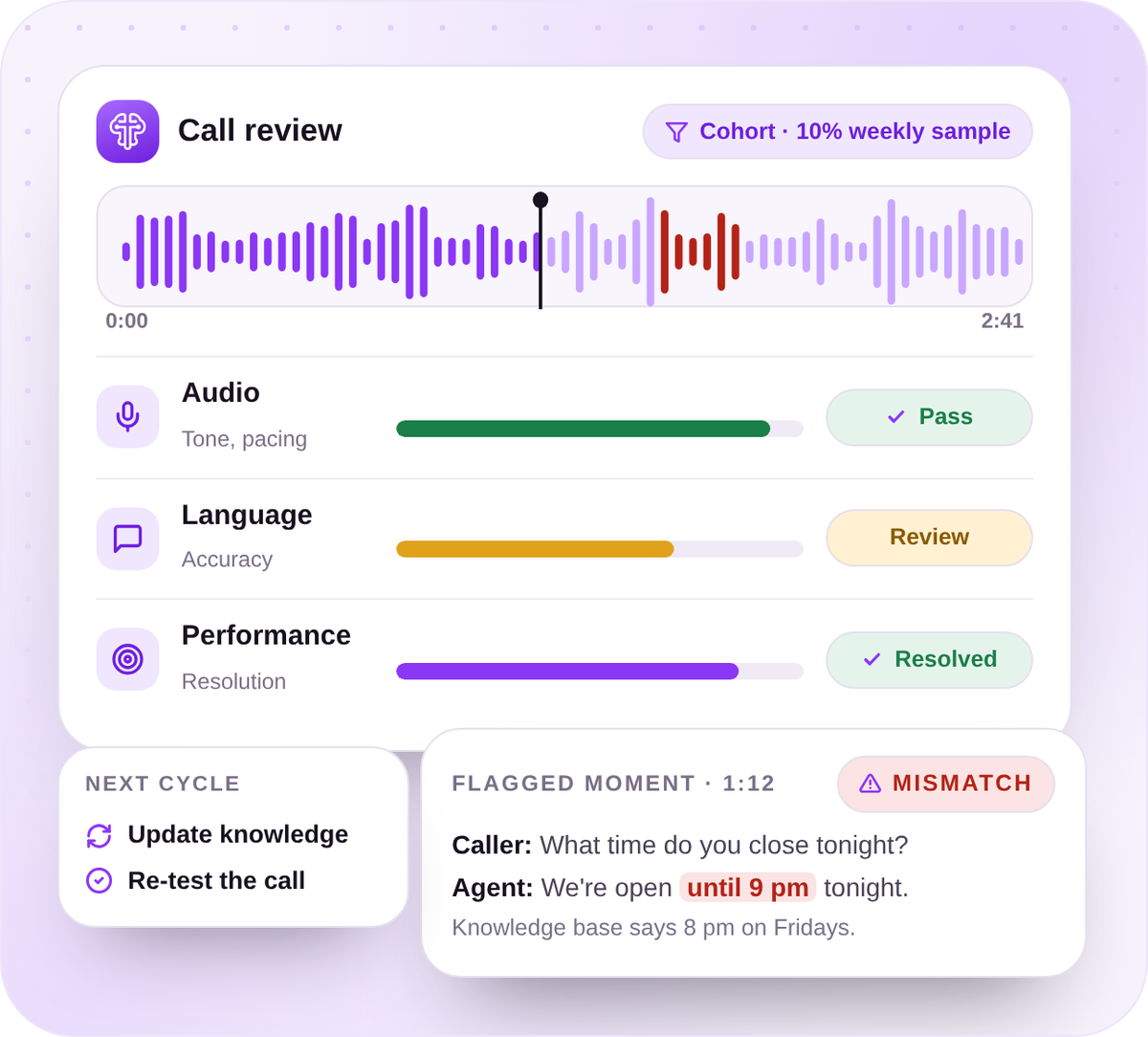
QA isn't just about reviewing calls anymore. It’s how voice agents stay reliable.
Get a demoAudio
Evaluate how human the agent sounds and how seamless the interaction feels by measuring naturalness, tonality, interruptions, response timing, and overall conversational flow.
Language
Determine whether the agent provided accurate, relevant, and appropriate responses by analyzing hallucinations, knowledge-base recall, transcription accuracy, and customer sentiment.
Performance
Determine whether the call achieved its intended outcome by analyzing resolution rates, tool execution, workflow transitions, latency, and transfer success.
Catch problems before your callers do.
A voice agent is only as good as the last call it handled. Ongoing QA turns every conversation into evidence you can act on.
Find issues early
Spot wrong answers, missed handoffs, and awkward moments in a sample of real calls, before they turn into complaints.
Improve faster
Every failed call points to a fix, whether it's a prompt, a workflow, or a knowledge base article. Changes rest on evidence, not guesswork.
Expand with confidence
Prove the agent on one use case first. Clear scores show when it's ready to take on more calls and more tasks.
Set up quality assurance in four simple steps.
- Step 1
Create a cohort
Choose which calls to review by agent, date range, call length, or post-call analysis fields. Then set a sampling percentage and a weekly maximum.
- Step 2
Define resolution criteria
Build QA around the outcomes your business cares about. Combine pass/fail conditions with performance metrics, and weight the scoring to reflect what matters most.
- Step 3
Investigate failures
Drill into failed calls, replay conversations, and review transcript evidence to see exactly where the interaction broke down.
- Step 4
Improve and repeat
Use QA findings to improve prompts, workflows, routing logic, and knowledge retrieval, then run the next cycle.
See how every call is performing.
Book a demo and we'll walk through a call review on your use case, then plan a pilot with weekly reviews alongside your team.